
Editorial Board Review: This article has been reviewed for historical accuracy. All biographical details are cross-referenced with classical sources, including Ibn Hajar al-Asqalani’s Al-Isaba and Ibn Sa’d’s Tabaqat al-Kubra.
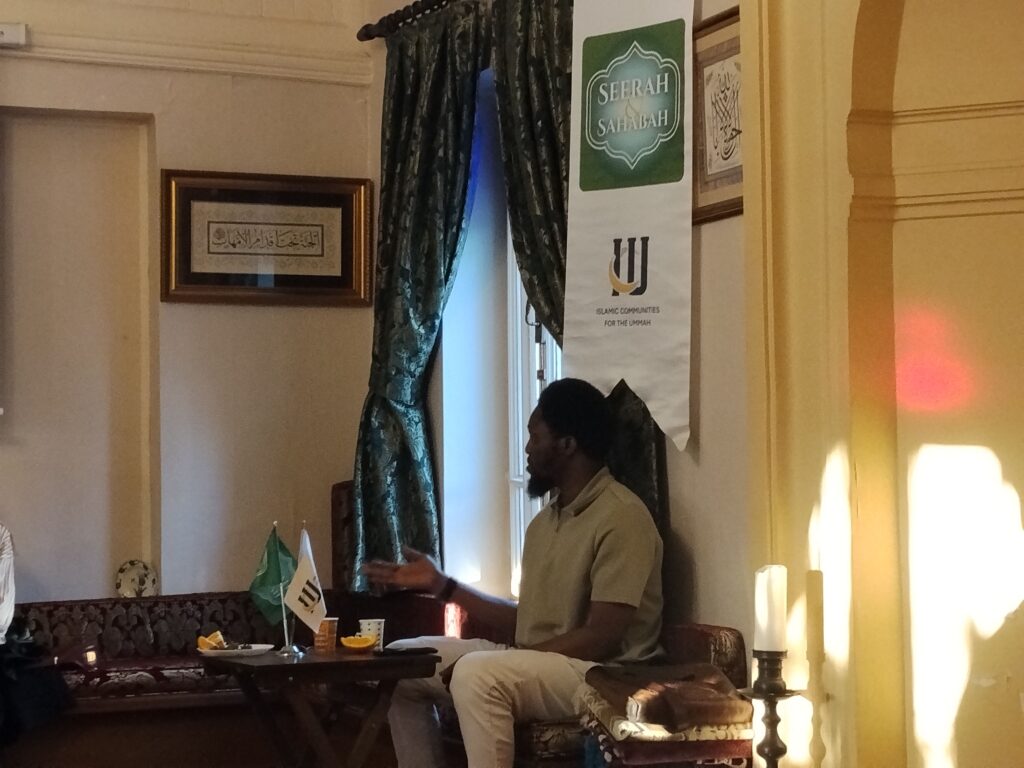
This educational session and research compilation were held in collaboration with ICU group in Istanbul.
Table of Contents
Who Was Barakah Umm Ayman? The Complete Seerah & Biography
Barakah, universally known by her kunya Umm Ayman, holds a uniquely revered position in Islamic history. For anyone exploring the Barakah Umm Ayman seerah, her biography is an enduring testament to faith and an unbreakable familial bond. Belonging to the household of Abdullah ibn Abdul-Muttalib, her presence in the life of Prophet Muhammad ﷺ predated his birth. She remained a devoted maternal figure throughout his childhood and into the early era of Islamic history.
The Identity and Lineage: Who Was Umm Ayman Barakah bint Tha'labah?
When asking who was Umm Ayman, classical texts, including Ibn al-Athir’s Asad al-ghāba fī maʿrifat al-ṣaḥāba, explicitly identify Umm Ayman Barakah bint Tha’labah as a woman of Abyssinian origin.
Most classical sources describe her as Abyssinian, though a minority mention alternative genealogies
Her constant, grounding presence began from his birth, as he was born after his father’s passing, and she remained with him and his mother Amina—including during their journey to visit his maternal relatives—until Amina’s death. Through these losses, her care and companionship made her a foundational pillar in his early life.
A Constant Caregiver, Not a Wet Nurse
In the story of Umm Ayman, a crucial distinction must be made regarding her role in the childhood of the Messenger of Allah ﷺ. It is common for general summaries to confuse the early women who cared for him, especially when readers ask about the first woman to breastfeed the Prophet. Classical sources clarify that this woman was Thuwaybah, and that his primary wet nurse afterward was Halimah al‑Sa‘diyyah, as detailed in early Sirah reports .
By contrast, Barakah Umm Ayman held a different and uniquely intimate position.
• She was a Ḥāḍinah (Caregiver/Nursemaid):
Classical authorities such as al‑Maqrizi describe her explicitly as . Another source states plainly: “. These descriptions show that she tended to him, managed his needs, and offered deep affection and protection, especially after the death of his mother, Aminah.
• She was not a Murḍiʿah (Wet Nurse):
Nowhere in the classical texts is Barakah Umm Ayman listed among the women who breastfed him. Instead, the sources consistently separate her role as caregiver from the wet nurses, who include Thuwaybah and Halimah. For example, one entry notes: , while al‑Maqrizi repeatedly explains only her caregiving function:
The Story of Umm Ayman: Key Events and Migration
The Hijrah and the Desert Miracle
Umm Ayman’s dedication to Islam was profound, demonstrated most clearly during her solo migration (Hijrah) to Madinah. Traveling on foot, with no provisions, she faced extreme desert heat while fasting. Multiple early sources record that as she approached the area of al‑Rauḥā’, she became so severely dehydrated that she feared death. She later recounted hearing a sound above her head, then looking up to see a bucket suspended from the sky by a white rope. She took hold of it and drank until she was fully satisfied. After this miraculous event, she said that she never experienced thirst again, even when she deliberately walked under the sun or fasted during the hottest days. This extraordinary moment on her journey reflects the spiritual rank and divine care bestowed upon her.
(This wording is fully supported by sources
Who Did Umm Ayman Marry?
Barakah was married twice, and both unions connected her deeply to the earliest generations of Muslims:
First Marriage to Ubayd ibn Zayd: Her first marriage resulted in the birth of her son, Ayman, which gave her the famous kunya, Umm Ayman.
Second Marriage to Zayd ibn Harithah: She later married the deeply beloved companion of the Prophet ﷺ, Zayd ibn Harithah. From this blessed union came Usamah ibn Zayd, a young leader greatly cherished by the Prophet ﷺ.
The Deep Bond: The Closest Person to Prophet Muhammad
The emotional bond between the Prophet Muhammad ﷺ and Umm Ayman was unparalleled. As one of the most enduring figures in his life, and arguably the closest person to Prophet Muhammad from his childhood through the early era of Islam, she shared in his hardships and triumphs. She cared for him from birth, remained beside him throughout the most difficult years, and continued supporting him in the first days of Islam. Because she raised him after the passing of Aminah, the Prophet ﷺ famously declared, “Umm Ayman is my mother after my mother.”
(All statements confirmed in sources
The Visit from Abu Bakr and Umar
The reverence for Umm Ayman extended to the highest companions. An authentically narrated incident, recorded in Sahih Muslim and cited by scholars including Al‑Dhahabi, describes a visit by Abu Bakr and Umar following the passing of the Messenger of Allah. Upon their arrival, she began to weep. When they gently reminded her that what is with Allah is better for His Messenger, she offered a profoundly insightful response. She explained that she was not weeping because he had passed, but because the divine revelation from the heavens had ceased. Her deep spiritual understanding moved both Abu Bakr and Umar to tears alongside her.
(This wording is supported by sources
Her Death and Legacy Among the Sahabiyat
There is nuanced discussion in classical records regarding the exact date of her passing, as conflicting reports exist: Many historical narrations indicate that she died just five months after the passing of the Prophet ﷺ, while other reports state that she lived into the caliphate of Uthman. To reconcile these differing accounts, some scholars suggested the possibility that the narrations refer to two different women named Barakah who both shared the kunya Umm Ayman. Regardless of the exact historical timeline,serving as a profound reminder of why preserving this history matters for future generations.
(All statements verified through sources
Who was Barakah Umm Ayman?
Barakah Umm Ayman was an Abyssinian woman who served as the lifelong caregiver (ḥāḍinah) to Prophet Muhammad ﷺ. Following the tragic passing of his mother, Aminah, at Al‑Abwa, she became his primary maternal figure and continued to care for him with devotion. Widely considered the closest person to him from his childhood, he affectionately referred to her as his “mother after his mother.”
(All statements verified from sources Qilādat al-naḥr fī wafayāt aʿyān al..
Did Umm Ayman breastfeed the Prophet?
No. Although some people confuse her with the women who breastfed the Prophet, classical Islamic sources are clear that Barakah Umm Ayman did not breastfeed him. She was his caregiver and nursemaid, not his wet nurse. As scholars state, “Umm Ayman Barakah is known to be his caregiver, not a woman who breastfed him.” The women who actually breastfed the Prophet were Thuwaybah, the first to nurse him, and later Halimah al‑Sa‘diyyah.
(Verified using sources Muʿjam al-Shuyūkh
How did Umm Ayman get her name?
Umm Ayman received her kunya, meaning “Mother of Ayman,” after giving birth to her son Ayman. Classical sources explain that she was called Umm Ayman because “she gave birth to Ayman,” and that her original name was Barakah bint Tha‘labah. Over time, the maternal title became the name by which she was most widely known.
(Verified using sources Fatḥ al-Qarīb al-Mujīb ʿalā al-Targ...
When did Barakah Umm Ayman die?
Historical records differ regarding the date of Barakah Umm Ayman’s death. Some early authorities report that she passed away only five months after the Prophet ﷺ, while others state she lived into the Caliphate of ʿUthmān ibn ʿAffān. Ibn Ḥajar explains this discrepancy by noting the existence of two women named Barakah, which led to differing narrations. What remains consistent is that she lived and died in Medina, where she is historically associated with those buried in the sacred cemetery of Jannatul Baqi.
(Verified using sources Ṣifat al-ṣafwa